
On October 27th and 28th, the Southern Regional Assembly participated in a FutureECOS study visit in Zadar, Croatia, with activities taking place in Zadar and the surrounding region. The visit formed part of the Interreg Europe-funded FutureECOS project, which aims to strengthen regional strategies to future-proof living space in growth corridor regions. Representing the Assembly was Niamh O’Sullivan.
The two-day programme provided an opportunity for partners to reflect on achievements delivered during the core phase of the project while exploring examples of sustainable regional development and innovative approaches to spatial planning in Croatia.
Day 1: Green Urbanism, Regional Development and Project Learning
The meeting commenced at the Youth Center Zadar with welcome remarks from representatives of ZADRA NOVA, the Ministry of Regional Development and EU Funds, and the FutureECOS Lead Partner. Presentations highlighted the importance of interregional cooperation in addressing challenges related to sustainable regional development and future-proofing living spaces.
Participants attended a session on Green Urbanism and Spatial Planning, where the City of Zadar presented its Green Urban Renewal Strategy and approaches to implementing green urban development projects. The Zadar Association of Architects also shared examples of its work in promoting high-quality urban planning, spatial culture and protection of the built environment.
A second session focused on the role of regional and local development agencies in supporting sustainable development. Representatives from the Lika-Senj County Development Agency (LIRA) and the Zadar County Rural Development Agency (AGRRA) presented their work in delivering development projects, supporting rural communities and implementing EU-funded initiatives.
During the afternoon, project partners presented their main achievements and results, stakeholder engagement experiences and lessons learned from the core phase of FutureECOS. Discussions also explored the project’s thematic findings, future policy improvements and communication priorities for the Follow-Up Phase.
Day 2: Site Visits and Good Practice Examples
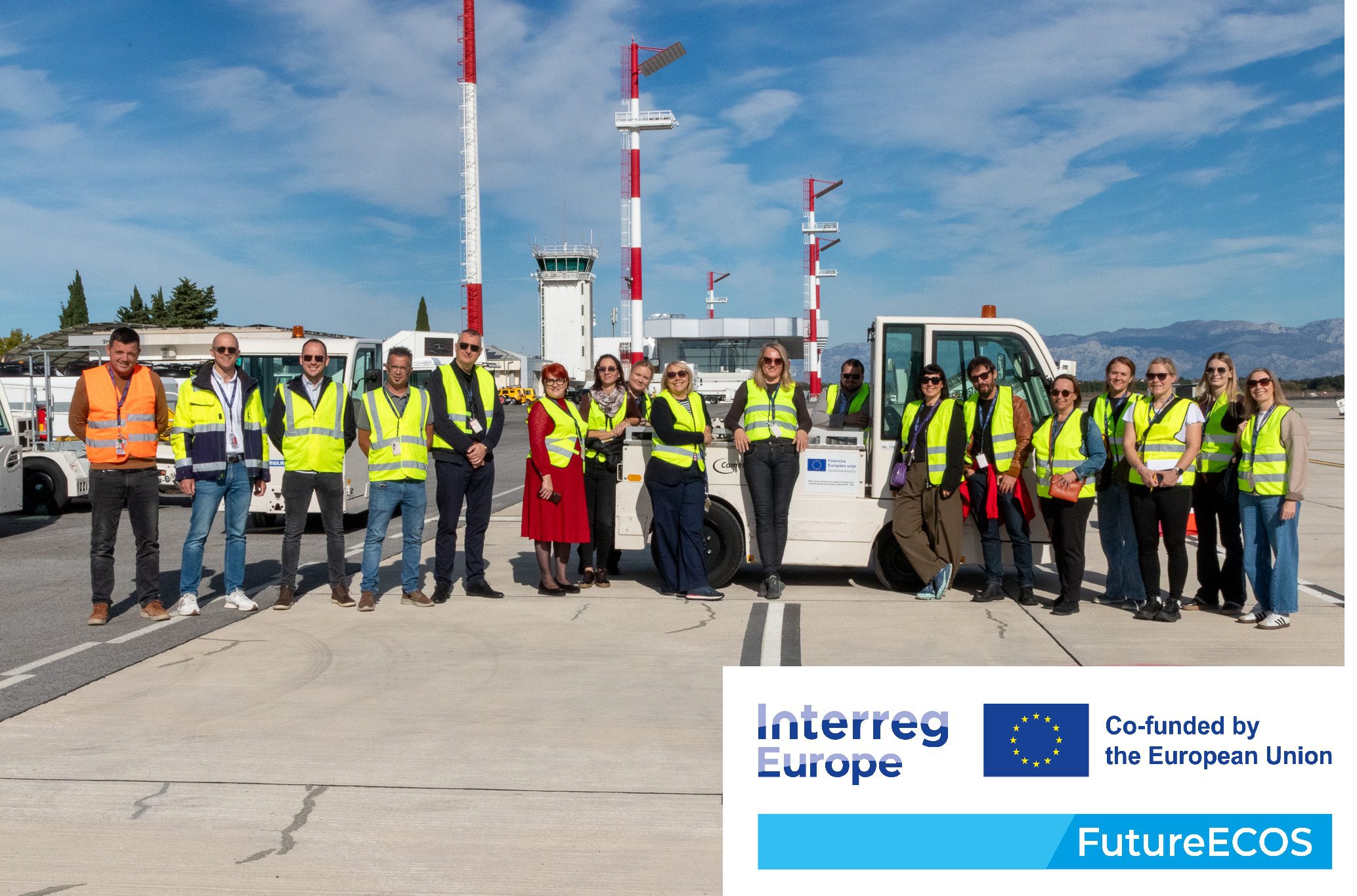
The second day included a visit to Zadar Airport, where participants learned about the airport’s role in supporting regional connectivity and economic development. The airport also showcased a number of energy-saving and emissions reduction measures supported through the National Recovery and Resilience Plan (NextGenerationEU), demonstrating how strategic investment can contribute to more sustainable transport infrastructure.
Partners were also presented with an innovative Mobile Pharmacies on Boats initiative developed by Zadar County, which provides access to healthcare services for island communities and demonstrates how public services can be adapted to meet the needs of dispersed populations. The initiative offered a practical example of how innovation in service delivery can help address geographic challenges and ensure equitable access to essential services.
An excursion to Krka National Park highlighted the rich historical and technological context of the area, with the remnants of Europe’s first example of a hydro-electric power station situated in the park, commissioned using Nikola Tesla’s polyphase alternating current (AC) system, who was born in the area also.
Key Insights
The interregional meeting highlighted the value of integrated approaches to spatial planning, sustainable development and service delivery. The examples presented in Croatia demonstrated how collaboration between public authorities, development agencies and local stakeholders can support resilient and attractive regions.
Particular insights were gained from the examples of green urban renewal, sustainable transport infrastructure, innovative public service delivery and place-based development approaches. These practices demonstrated the importance of combining long-term strategic planning with practical local solutions to address contemporary regional challenges.
Participation in the meeting will help inform the Southern Regional Assembly’s ongoing work on regional policy development and contribute to the implementation of FutureECOS project objectives in the Southern Region.
Engagement in FutureECOS continues to strengthen the Assembly’s involvement in European cooperation and support the development of sustainable, innovative and future-ready communities.